
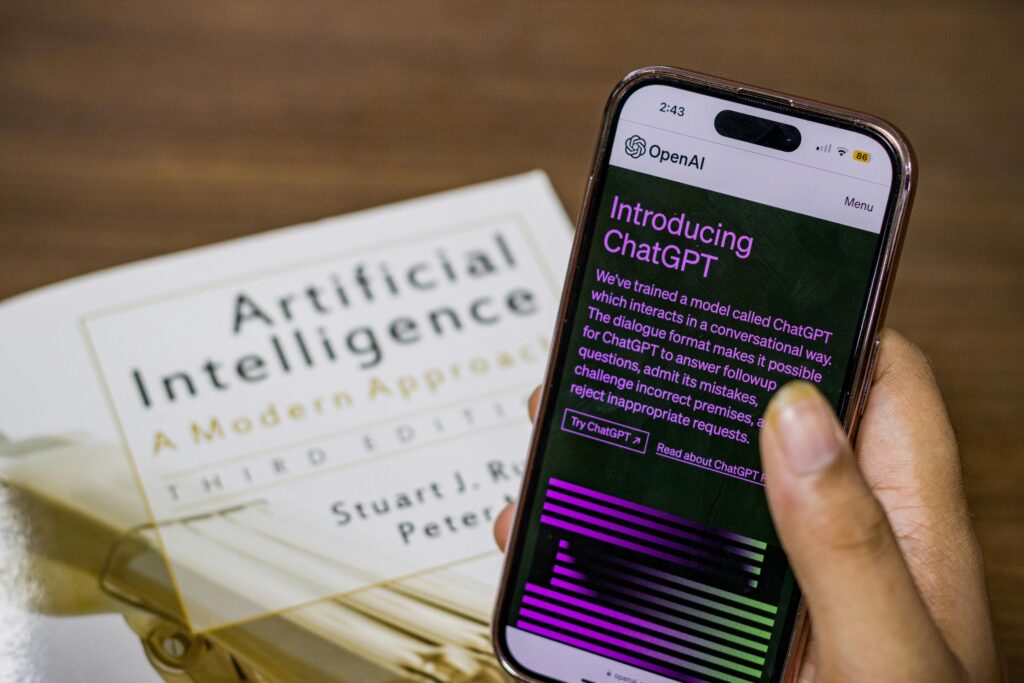
What Is AI and What Does It Do?
Artificial Intelligence (AI) is the simulation of human intelligence by computer systems. In simple terms, it means building machines that can think, learn, reason, and make decisions auto — tasks that traditionally required a human brain.
AI systems can understand and generate human language, recognize faces and voices, predict outcomes from data, automate repetitive tasks, and even help drive cars or diagnose diseases. AI is not science fiction anymore. It is embedded in your smartphone, your email inbox, your bank’s fraud detection, and your online shopping cart. It is the engine powering the modern digital economy — and it is only getting smarter.
Artificial Intelligence is no longer a concept locked inside research labs or science fiction movies. It is here, it is real, and it is reshaping every industry, every job, and every aspect of daily human life at a pace that no previous technology has ever matched.
From the moment you wake up and check your phone — where an algorithm has already sorted your notifications — to the moment you stream a show that was recommended specifically for you before you even knew you wanted it, AI is quietly orchestrating the world around you. It filters your emails, approves your loans, navigates your GPS, translates your messages, and even helps doctors detect cancer earlier than ever before.
Yet despite its enormous presence in modern life, most people still cannot answer the most basic question: What is AI, exactly?
This guide is built to change that. Whether you are a curious beginner, a business owner exploring AI tools, a student researching technology, or an entrepreneur looking to gain a competitive edge — this is the most complete, plain-English breakdown of Artificial Intelligence available. We cover what it is, how it works, what types exist, how it is used in the real world, and most importantly, how you can start using it today — many times for free.
Let’s begin.
What Is AI vs Machine Learning? (And Why It Matters)
One of the most ask common points of confusion is the difference between AI and Machine Learning (ML). Here’s is explained the real means
Artificial Intelligence (AI) | Machine Learning (ML) | |
Definition | The idea of machines replicating human thinking and decision-making abilities. | A subset of AI where machines learn from data |
Scope | Wider — includes logic, reasoning, NLP, robotics | Narrower — focused on pattern recognition and prediction |
Example | A chess-playing computer | A spam filter that improves over time |
Needs Rules? | Sometimes programmed with rules | Discovers rules on its own from data |
The simplest way to remember it: All Machine Learning is AI, but not all AI is Machine Learning. Think of AI as the universe, and Machine Learning as one of its galaxies.
Deep Learning is yet another subset — a branch of Machine Learning that uses neural networks inspired by the human brain. Tools like ChatGPT and image generators are powered by Deep Learning.
AI ⊃ Machine Learning ⊃ Deep Learning
Types of Artificial Intelligence Systems
AI is not a single technology — it comes in several forms, each with distinct capabilities and use cases. Here are the main types of artificial intelligence systems used today:
- Reactive Machines — The most basic form of AI. These systems react to current input but have no memory of the past and cannot learn or improve over time. IBM’s Deep Blue chess computer is a classic example — brilliant at chess, useless at anything else.
- Limited Memory AI — This is the most common type in use today. These systems learn from historical data and use that learning to make decisions. Self-driving cars, ChatGPT, recommendation algorithms, and fraud detection all fall into this category.
- Theory of Mind AI (Emerging) — This future class of AI would understand human emotions, beliefs, and social dynamics. It doesn’t fully exist yet, but researchers are actively working toward it. Imagine a robot that understands when a person is stressed and adjusts its approach accordingly.
- Self-Aware AI (Theoretical) — The most advanced and currently hypothetical form. A self-aware AI would have its own consciousness and sense of self. This exists only in research papers and movies — for now.
Types of Artificial General Intelligence (AGI)
AGI is the long-term ambition of AI research: building machines that can think, learn, and reason across all domains like a human. Unlike today’s “narrow AI,” which excels at one specific task, AGI would be flexible, adaptive, and broadly capable.
Narrow AGI represents a transitional phase where AI systems handle multiple domains at a high level — built from specialized models working together. Some researchers argue that GPT-4 and its successors show early signs of this.
Full AGI describes a system that can genuinely generalize knowledge from one domain to another, just like humans do. A full AGI could function as a doctor, lawyer, engineer, and artist — all in one system.
Superintelligent AGI (ASI) goes beyond full AGI — a system that surpasses the combined intellectual capability of all humans. This is the scenario that thinkers like Elon Musk and Sam Altman debate most passionately. It remains theoretical, but is taken seriously across the scientific community.
Where are we now? We are firmly in the era of Narrow AI. AGI may be 10–50 years away — or sooner, depending on who you ask.
What Is AI Inferencing?
AI Inferencing is the process of running a trained AI model to make predictions or decisions on new, real-world data.
Think of it this way — training is like going to school, where the AI learns from massive datasets. Inferencing is like using that education on the job, applying what it learned to answer questions or solve problems in real time.
When you upload a photo and an AI identifies the objects in it — that’s inferencing. When you type a prompt into ChatGPT and receive a response — that’s inferencing. It happens billions of times per day across the globe.
Why does inferencing matter? It determines the speed of AI responses, drives the cost of running AI at scale, and is the reason companies invest billions in specialized hardware like NVIDIA GPUs. Edge AI — inferencing directly on your device rather than in a cloud server — is one of the fastest-growing trends in the field, especially for privacy and speed.
What Is AI Arbitrage?
AI Arbitrage means using AI tools before most people do — so you can work faster, spend less money, and get better results than your competitors.
The word “arbitrage” originally comes from finance, where people make money by taking advantage of price differences. In the AI world, it means noticing the gap between what AI is capable of doing and what people are actually using it for — and making profit from that gap.
In simple terms:
“ If others are working manually and you use AI smartly, you win the advantage.”
Examples of AI Arbitrage in Action:
Industry | Traditional Way | AI Arbitrage Way |
Content Marketing | 5 writers at $5,000/month | AI + 1 editor for $500/month |
Customer Support | 20-person call center | Chatbot handles 80% of queries |
E-Commerce | Manual product descriptions | AI generates 10,000 listings overnight |
Legal | Associates review documents | AI reviews contracts in seconds |
Real Estate | Agent writes listings manually | AI writes, translates & optimizes listings |
What Is AI and How to Use It? (A Practical Starter Guide)
Understanding AI theoretically is one thing. Knowing how to actually use it & What is ai , where the value lives. Here’s how to get started today — even as a complete beginner:
Step 1 — Identify Your Problem. What task do you spend the most time on? Writing? Research? Customer emails? Design? AI has a tool for nearly everything.
Step 2 — Choose the Right Tool. Match the AI to your need (see the free tools list below). Don’t use every tool at once — pick one and get good at it first.
Step 3 — Learn to Prompt Well. AI is only as good as your instructions. Instead of “Write a blog post,” try: “Write a 1,000-word SEO blog post about solar panels for homeowners in Texas. Use a friendly tone, include 5 subheadings, and end with a call to action.” Specificity is everything.
Step 4 — Review and Refine. AI is a co-pilot, not an autopilot. Always review outputs, fact-check, and add your own expertise and voice. AI gives you a head start — your judgment gives it quality.
Step 5 — Build a Workflow. The most powerful AI users integrate it into daily systems, not just occasional experiments. Automate the repetitive. Amplify the creative.
Free AI Tools You Should Be Using Right Now
You don’t need to spend thousands of dollars to get started with AI. Here are the best free AI tools available today, organized by use case:
 Writing & Content Creation
Tool | What It Does | Free? |
ChatGPT | Conversational AI, writing, coding, analysis | Yes — GPT-4o mini free |
Claude (Anthropic) | Long-form writing, document analysis, deep reasoning | Yes — free tier available |
Google Gemini | Writing, search integration, Google Workspace | Yes |
Copy.ai | Marketing copy, ads, email sequences | Yes — 2,000 words/month |
Rytr | Blog posts, social captions, product descriptions | Yes — 10k chars/month |
 Image & Design Generation
Tool | What It Does | Free? |
Adobe Firefly | AI image creation, background removal | Yes — limited credits |
Microsoft Designer | Images from text prompts (DALL-E powered) | Yes |
Canva AI | Design + AI image generation combined | Yes |
Leonardo.Ai | High-quality AI art and concept design | Yes — 150 tokens/day |
 Audio & Video
Tool | What It Does | Free? |
ElevenLabs | Realistic AI voice generation | Yes — 10k chars/month |
Kling AI | AI video generation from prompts | Yes — limited credits |
Descript | Podcast/video editing with AI transcript editing | Yes |
Suno | Create full AI-generated songs in seconds | Yes |
Productivity & Research
Tool | What It Does | Free? |
Notion AI | Meeting summaries, project planning, writing | Yes (limited) |
Perplexity AI | AI-powered real-time search & research | Yes |
Zapier AI | No-code workflow automation | Yes (limited) |
Beautiful.ai | AI-powered presentation maker | Yes (limited) |
Coding & Development
Tool | What It Does | Free? |
GitHub Copilot | AI code suggestions inside your editor | Free for students & OSS |
Replit AI | Code in the browser with AI assistance | Yes |
v0 by Vercel | Generate UI components from plain descriptions | Yes (limited) |
 USAbuzz360 Pro Tip: Start with ChatGPT or Claude for general tasks, Canva AI for design, and Gemini for image . Master three tools deeply before expanding your stack.
The Future of AI: What’s Coming Next?
The pace of AI development is breathtaking. Here’s what’s on the horizon for 2025 and beyond:
Agentic AI — AI that doesn’t just respond, but takes autonomous actions: booking meetings, executing code, managing files, placing orders. This is already beginning with tools like Claude’s computer use and OpenAI’s Operator.
Multimodal AI — Systems that simultaneously understand text, images, audio, and video. GPT-4o and Gemini are early examples.
AI in Healthcare — From earlier cancer detection to designing new drug compounds in days rather than years.
Personal AI Assistants — Your own AI that knows your schedule, communication style, preferences, and history — acting as a true digital second brain.
AI Regulation — Governments worldwide, including the EU and US, are actively building guardrails around AI development. How this plays out will shape the industry for decades.
Key AI Terms Cheat Sheet
Term | Plain English Meaning |
Algorithm | A set of rules an AI follows to solve a problem |
Training Data | The massive dataset an AI learns from |
Neural Network | An AI structure inspired by the human brain |
Large Language Model (LLM) | AI trained on billions of words to understand and generate text |
Prompt | The instruction or question you give to an AI |
Token | The basic unit of text an AI processes (roughly 1 word) |
Hallucination | When AI confidently states something false |
Fine-Tuning | Training an AI further on specialized or custom data |
Artificial Intelligence isn’t just another tech trend — it’s transforming the way we think, work, and innovate. From classrooms to boardrooms, AI is reshaping how problems are solved and ideas are brought to life. Whether you’re a student, entrepreneur, business owner, or simply curious, understanding AI has become essential. It’s quickly becoming the new form of literacy in the digital age.
The best part? You don’t need to be a programmer or tech expert to use it. With today’s accessible tools and a mindset open to learning, anyone can start leveraging AI to save time, boost productivity, discover new income opportunities, and stay competitive.
The real question isn’t “What is AI?” anymore.
It’s “How will you use it to create your advantage?”AN

USA BANK ONLINE – TOP BANKS
USA Bank Online: Top Banks, Mortgages & Nearby Branches (2026 Guide) Table of Contents Facebook Twitter Pinterest Linkedin Youtube Banking in the United States has

Top 10 banks in usa : Largest & Best US Banks
🏦 Top 10 Banks in USA (2026): Largest & Best US Banks You Can Trust Table of Contents Facebook Twitter Pinterest Linkedin Youtube Choosing the

5G TECHNOLOGY
5G Technology Benefits 2026: How It Will Transform Your Life Table of Contents Facebook Twitter Pinterest Linkedin Youtube The arrival of 5G technology is not

The Future of Connectivity: T-Mobile 5G Network, Wireless Home Internet, and the Rise of 6G
The Future of Connectivity: T-Mobile 5G Network, Wireless Home Internet, and the Rise of 6G T Mobile 5g network : The global telecom industry is

US Dollar Currency: Will It Remain the World Reserve Curency
Will the US Dollar Remain the World’s Reserve Currency in 2026? For decades, the US dollar has been the world’s dominant reserve currency, shaping global

NYC Real Estate in 2026: Licensing, Classes, Management Companies & Market Insights
NYC Real Estate in 2026: Licensing, Classes, Management Companies & Market Insights Facebook Twitter Pinterest Linkedin Youtube Table of Contents If you’re exploring NYC real