What Is 5G? 5G Technology Explained — Speed, How It Works, Coverage, Benefits & the Future (2026 Complete Guide)
5G — fifth-generation wireless network technology — is the current global standard for mobile communications. It delivers peak download speeds up to 10 Gbps, end-to-end latency as low as 1 millisecond, and the ability to connect up to one million devices per square kilometre simultaneously. It is not merely a faster phone signal. It is the communications backbone that makes autonomous vehicles, remote robotic surgery, smart cities, and industrial automation practically possible for the first time.
If you have searched “what is 5G,” “what does 5G stand for,” or “what does 5G mean,” the simplest answer is this: 5G is the fifth generation of mobile networks, and the “G” simply stands for generation.
Table of Contents
What Does 5G Mean? A Generation-by-Generation History
The word “5G” is simply shorthand for fifth-generation wireless technology. Every generation of mobile networks has introduced a step-change — not just in speed, but in what the network fundamentally enables society to do.
1G (1980s): Analog voice calls only. The first mobile phones. No data capability whatsoever.
2G (1990s): Digital voice calls and SMS text messaging. The introduction of basic mobile security through digital encryption.
3G (Early 2000s): Mobile internet access for the first time. Enabled early smartphone browsing, email on a phone, and low-quality video streaming.
4G LTE (2010s): High-speed mobile broadband. Made HD video streaming, social media, ride-sharing apps, and mobile gaming viable. Redefined how people use smartphones.
5G (2019–present): Ultra-fast speeds, near-zero latency, massive device connectivity, and network programmability. Does not just improve what smartphones do — it enables entirely new categories of technology that 4G cannot support at all.
Each generation replaced its predecessor not because the previous technology was broken, but because the ambitions of the digital economy outgrew what the network could deliver. 5G exists because 4G, for all its improvements, is fundamentally too slow and too limited to power autonomous vehicles, connected factories, remote surgery, and smart city infrastructure at scale.
What is 5G? 5G is the fifth generation of wireless network technology, designed to deliver ultra-fast speeds, low latency, and massive connectivity. Unlike 4G, 5G isn’t just about faster smartphones — it powers smart cities, autonomous vehicles, remote healthcare, and the Internet of Things (IoT).
What does 5G mean? It represents a major leap from previous generations, combining low, mid, and high-frequency bands, including mmWave, to support high-speed data and dense device networks.
How does 5G technology work?
One of its key features is network slicing, which allows multiple virtual networks to operate on the same infrastructure. For example, an ambulance can transmit patient vitals on a low-latency slice, a commuter can stream music on another, and a factory can run robotics on a third — all without interference. Beamforming directs signals precisely to devices, while small cell networks ensure dense, reliable coverage in urban areas.
5G vs 4G: Compared to 4G LTE, 5G offers up to 10x faster speeds, latency as low as 1 millisecond, and the ability to connect millions of devices per square kilometer.
The T-Mobile 5G network provides nationwide coverage in the USA, including Ultra Capacity 5G and 5G home internet. Beyond speed, 5G enables smart homes, autonomous vehicles, industrial automation, and IoT applications, making it a transformative technology for businesses and consumers.
Is 5G safe? According to the WHO and FCC, 5G uses non-ionizing radiation within safe limits, just like previous generations.
The future is bright with 5G-Advanced 2026, offering AI-optimized networks, faster speeds, and massive IoT deployment — bridging the gap to 6G networks expected around 2030.
In short: What is 5G? It’s the next-gen wireless technology transforming how we connect, work, and live, from T-Mobile 5G network coverage to global innovations across industries.
References:
FCC – 5G | Qualcomm – What is 5G | T-Mobile 5G Network | GSMA – 5G Insights | WHO – EMF Safety
What Is 5G Technology and How Does It Work?
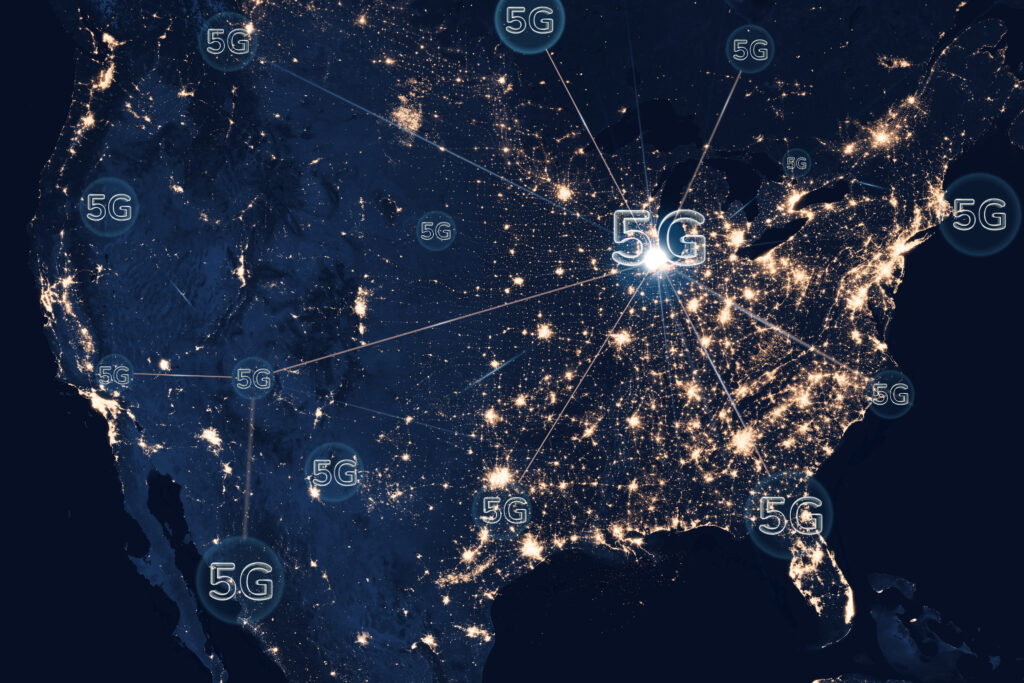
Understanding WHAT IS 5G & works requires looking at four core technical innovations that distinguish it from every previous generation of wireless network. 5G is not simply a faster version of 4G — it is a fundamentally different architecture built around intelligence, precision, and programmability.
Beamforming — Targeting the Signal Directly
A traditional 4G antenna broadcasts its signal in every direction simultaneously, like a lightbulb illuminating an entire room whether someone is there or not. 5G beamforming replaces that inefficient broadcast with a precisely directed beam.
5G TECHNOLOGY base stations use phased arrays of dozens to hundreds of individual antenna elements that can be tuned independently in nanoseconds. The system detects the exact location of your device and fires a concentrated beam of signal directly at it — continuously tracking and adjusting as you move. The result is dramatically stronger connections, significantly less interference between simultaneous users, and far more efficient use of the radio spectrum. This is why a single 5G tower can serve hundreds of users at full speed simultaneously, something 4G towers are simply not engineered to do.
Massive MIMO — Multiplying Antenna Capacity
MIMO stands for Multiple Input, Multiple Output. A standard 4G base station typically has 8 antenna elements. A 5G base station using Massive MIMO has 64, 128, or even 256, each transmitting and receiving independently. Combined with beamforming, Massive MIMO multiplies the total capacity of a single tower dramatically — which is why 5G handles packed stadiums, festivals, and airports where 4G networks historically collapse under load.
5G Network Slicing — One Physical Network, Multiple Virtual Networks
5G network slicing is the most consequential innovation for enterprise and industry, and it is only available on standalone 5G networks. It allows a single physical 5G infrastructure to be divided into multiple independent virtual networks, each with its own dedicated bandwidth, latency guarantee, and security profile — all running simultaneously.
In practice, what is 5G becomes clear when looking at real-world applications of its advanced features. For example, an ambulance can operate on a guaranteed ultra-low-latency 5G network slice to transmit patient vitals in real-time. Meanwhile, a commuter on the same street streams music on a separate 5G slice, and a nearby factory runs robotic automation on a third slice with precise timing guarantees. None of these activities interferes with the others. This level of network programmability and reliability is a defining feature of what 5G technology is and how it works, and it is not possible on any previous generation like 4G LTE.
Small Cell Infrastructure — Denser Network, Better Coverage
Because high-frequency 5G signals travel shorter distances than 4G signals, 5G networks rely on a dense grid of small cell stations rather than solely on large, widely-spaced towers. These small cells — roughly the size of a shoebox — are installed on streetlights, building facades, utility poles, and bus shelters. This dense placement is what makes high-band mmWave 5G viable in urban environments and allows the network to support enormous device density in small geographic areas.
5G Speed — Real Numbers, Not Just Headlines
5G speed claims in carrier advertising — “up to 10 Gbps!” — are peak theoretical values measured in ideal lab conditions. Real-world performance varies by spectrum band, user density, and environment. Here is an honest picture of what 5G actually delivers in 2026.
Low-Band 5G (sub-1 GHz): Average downloads of 50–250 Mbps. Modest improvement over 4G, but excellent indoor and rural coverage. This is the band that gave T-Mobile its early nationwide footprint.
Mid-Band 5G (1–6 GHz): Average downloads of 200–900 Mbps, with occasional bursts approaching 1 Gbps. Latency of 10–20 ms. This is the 5G that most Americans in cities and suburbs connect to every day in 2026 — the practical workhorse of the US 5G ecosystem.
mmWave 5G (24–100 GHz): Sustained speeds of 800 Mbps to 3 Gbps in real deployment, with laboratory peaks above 4 Gbps. Latency of 1–5 ms. Available in dense urban hotspots, stadiums, and airports.
4G LTE (for context): Average downloads of 30–50 Mbps, peaks around 150 Mbps, latency 20–50 ms.
What does mid-band 5G speed mean in practical terms? A 4K Ultra HD movie — approximately 15 GB — takes roughly 40 minutes to download on 4G. On mid-band 5G, it arrives in under 2 minutes. On mmWave 5G, under 20 seconds.
In documented field testing conducted in 2025–2026, standalone 5G networks delivered sustained download speeds exceeding 950 Mbps to standard consumer smartphones in real urban environments — not controlled labs. (US NEWS )
5G vs 4G LTE — The Head-to-Head Comparison
The 5G vs 4G question matters most when you examine applications and industry capability, not just headline speeds.
Download Speed: 5G peaks at 10 Gbps versus 4G’s 150 Mbps peak. Real-world averages: 5G delivers 200–900 Mbps versus 4G’s 30–50 Mbps.
Latency: 5G achieves 1–20 ms versus 4G’s 20–50 ms. This gap is imperceptible to a human scrolling a social feed — but at 100 km/h, those extra 49 milliseconds represent 1.36 metres of vehicle travel with zero corrective input from a safety system. At 5G’s 1 ms, that distance shrinks to 2.7 centimetres. That arithmetic is why autonomous vehicles require 5G — 4G is too slow to be safe.
Device Density: 5G supports one million connected devices per square kilometre versus approximately 100,000 on 4G — a tenfold increase that makes large-scale IoT infrastructure viable.
Network Slicing: Available on standalone 5G. Impossible on 4G.
Autonomous Vehicle Support: 5G enables it. 4G latency is too high for safety-critical V2X communication.
Remote Robotic Surgery: 5G supports it at 1 ms latency. 4G latency introduces unacceptable risk.
Energy Efficiency: 5G consumes approximately 90% less energy per bit transmitted than 4G — critical as global data traffic doubles roughly every two years.
mmWave 5G Explained — The Three Spectrum Bands
Not all 5G is identical. The three spectrum bands — low, mid, and high — each have distinct performance characteristics, and knowing which one you are actually connected to tells you what your connection can realistically do.
Low-Band 5G (Sub-1 GHz) travels the farthest of any 5G signal and penetrates buildings effectively. Speeds are modest — 50 to 250 Mbps — but coverage is wide and reliable. T-Mobile used low-band to build its early national footprint and to bring 5G to rural and suburban areas quickly.
Mid-Band 5G (1–6 GHz) is the sweet spot. The 2.5 GHz and C-band (3.7–3.98 GHz) frequencies deliver 200 Mbps to 1 Gbps with 10–20 ms latency and good building penetration. This is the 5G that most Americans use in practice today — fast enough to transform everyday experience, with enough range to serve entire cities and suburbs without a tower on every corner.
mmWave 5G (24–100 GHz) is the ultra-fast, ultra-short-range tier that Verizon markets as “Ultra Wideband.” It delivers 1–10 Gbps with 1–3 ms latency — genuinely faster than most home fiber connections. The physical limitation: mmWave signals travel only a few hundred metres in open air, are absorbed by rain, and cannot penetrate walls, glass, or even dense foliage. mmWave is deployed in stadiums, airports, convention centres, and dense city street corridors where massive bandwidth is needed in a small area. It is not a general coverage technology.
Standalone 5G vs Non-Standalone 5G
This is the most under-reported distinction in consumer 5G coverage — and it matters enormously.
Non-Standalone 5G (NSA) adds a 5G radio layer on top of an existing 4G core network. Faster downloads arrive, but network slicing, true ultra-low latency, and advanced 5G-Advanced features remain unavailable because the 4G core still controls the network’s intelligence. Most initial US 5G from 2019 to 2022 was non-standalone.
Standalone 5G (SA) is a fully independent network with a native 5G core. It removes all 4G dependency and unlocks the complete 5G feature set: network slicing, guaranteed ultra-low latency for mission-critical applications, edge computing integration, and the full roadmap of 5G-Advanced upgrades. T-Mobile operates the largest standalone 5G core in the United States. Verizon and AT&T are expanding standalone deployment aggressively through 2026.
For enterprise buyers, private network operators, and industrial applications where network slicing, deterministic latency, or advanced IoT connectivity is required — standalone 5G is not a nice-to-have. It is the entire point of the upgrade.
5G Benefits and Real-World Applications
The real-world benefits of 5G are most visible not on a smartphone benchmark but in the industries it is actively reshaping across America right now.
Autonomous Vehicles: Self-driving cars require vehicle-to-everything (V2X) communication with traffic signals, other vehicles, road sensors, and central traffic management — all in under 10 milliseconds. 5G’s latency and network slicing make this reliable at highway speeds. Ford, GM, and Waymo are integrating 5G V2X into active autonomous vehicle programmes.
Remote Surgery and Telehealth: 5G remote surgery has moved from research concept to clinical reality. Hospitals in Shanghai and Barcelona demonstrated successful complex robotic procedures performed by surgeons operating from hundreds of kilometres away over standalone 5G in 2025. The threshold for safe robotic surgery is latency below 10 ms — achievable on 5G, not on 4G. For rural America — where surgical specialists are scarce — this capability has direct life-saving implications.
Smart Cities: Kansas City, Columbus, and San Jose are among the US cities that have deployed 5G-connected traffic systems, energy management infrastructure, air quality monitoring, and emergency response networks. Early data from Kansas City’s smart corridor showed a 15% reduction in intersection congestion after 5G integration.
5G IoT Applications: Private 5G networks inside factories connect thousands of sensors, robotic arms, and autonomous guided vehicles with guaranteed millisecond precision. Unlike shared Wi-Fi, private 5G delivers deterministic performance. Boeing, General Motors, and Honeywell operate private 5G networks in US production facilities as of 2026.
Smart Agriculture: Midwest farms are deploying 5G-connected soil sensors, coordinated drone swarms, and AI-guided autonomous tractors in real time. Early Iowa pilot programmes reported a 30% reduction in water usage and a 12% increase in crop yields from precision 5G-enabled agriculture.
5G Home Internet (Fixed Wireless Access): T-Mobile Home Internet and Verizon 5G Home Internet have collectively served over 8 million US households. For suburban and rural Americans without access to fiber, 5G FWA delivers 100–500 Mbps at $50–60 per month with no cable installation and no data caps on most plans.
Cloud Gaming: Xbox Cloud Gaming, NVIDIA GeForce NOW, and PlayStation Cloud all report significantly lower input lag and higher sustained bitrates on 5G mid-band versus 4G, making console-quality cloud gaming genuinely competitive with local hardware for the first time.
AR and VR: Cloud-rendered immersive experiences require sustained high bandwidth and low jitter simultaneously. 5G delivers both, enabling untethered augmented and virtual reality in retail, surgical training, military simulation, and remote industrial maintenance. (CISCO)
T-Mobile 5g network Coverage and US Carrier Comparison
5G network coverage across the USA now reaches the majority of the American population, with all three major carriers having made substantial mid-band spectrum investments. Here is where each stands as of 2026.
T-Mobile’s 5G network leads the industry in both overall 5G coverage and mid-band performance. Their 2020 Sprint acquisition provided exclusive access to 2.5 GHz spectrum — globally recognised as the ideal 5G mid-band frequency for balancing speed, range, and building penetration. T-Mobile 5G coverage extends to over 300 million Americans on their standalone 5G core — the largest in the country. Independent testing by Opensignal and Ookla consistently places T-Mobile first in 5G availability, median download speeds, and 5G time-of-use across the US.
Verizon leads in peak mmWave speed in select dense urban markets. Their Ultra Wideband mmWave network has documented sustained speeds exceeding 3 Gbps in New York, Los Angeles, Chicago, and Boston hotspots. Their C-band mid-band rollout has substantially improved suburban coverage through 2025–2026.
AT&T has aggressively deployed C-band spectrum and is competitive in urban and suburban markets, with particular strength in Southeast and Texas markets. AT&T’s FirstNet dedicated public safety network — built on 5G infrastructure — serves as a meaningful differentiator for government and emergency services customers.
More information about current US 5G infrastructure is available through the Federal Communications Commission at fcc.gov/5g.
5G Home Internet — Fixed Wireless Access Explained
5G home internet — technically Fixed Wireless Access, or FWA — delivers broadband to homes using 5G tower signals received by a dedicated router, with no cable or fiber installation required. It is one of the fastest-growing telecom products in America, particularly for suburban and rural households.
Real-world speeds for FWA customers on mid-band 5G typically fall between 100 and 500 Mbps for downloads, with latency of 15–40 ms — comparable to cable broadband and fully adequate for 4K streaming, video calls, remote work, and casual gaming | 5g network speed
The key advantage over cable is simplicity: no installation appointment, no contracts on most plans, no data caps, and no dependence on aging copper infrastructure. Pricing at $50–60 per month is competitive with or cheaper than cable in most US markets.
The honest limitation: FWA customers share tower capacity with mobile users, meaning performance can vary during peak evening hours in densely populated areas. For households where fiber internet is available at a competitive price, fiber remains the gold standard for reliability and consistent high-speed performance. For the tens of millions of American households where it is not — which includes the majority of suburban and rural ZIP codes — 5G FWA is typically faster and more reliable than the cable or DSL alternatives available.
Is 5G Safe? Health Facts vs Myths
Is 5G safe? became one of the most widely searched technology questions of the early 2020s, fuelled primarily by viral misinformation. Here is a precise, evidence-grounded answer. | 5g network speed
The Physics: 5G uses radio frequency electromagnetic radiation — non-ionizing, the same category as FM radio, Wi-Fi signals, and visible light. Non-ionizing radiation does not carry sufficient energy to ionize atoms, break chemical bonds, or damage DNA. This is the fundamental physical mechanism required to cause cancer or cellular injury — and 5G radio waves cannot perform it. This distinguishes 5G completely from ionizing radiation such as X-rays and gamma rays, which do carry that risk at sufficient doses.
What the WHO says: The World Health Organization has reviewed decades of research on radio frequency electromagnetic fields from mobile phones and base stations and found no confirmed adverse health effects in humans from exposure below international guideline limits. Detailed research is published at who.int/health-topics/electromagnetic-fields.
What the FCC says: The Federal Communications Commission requires all wireless devices and all network infrastructure — including every 5G tower and handset — to comply with strict RF exposure limits derived from peer-reviewed biological research, with significant safety margins built in.
What ICNIRP says: The International Commission on Non-Ionizing Radiation Protection updated its guidelines in 2020 specifically to cover the higher-frequency 5G bands and confirmed existing safety standards are protective against all known biological effects of RF exposure.
The COVID-19 myth: The claim that 5G towers spread, cause, or activate COVID-19 is biologically and physically impossible. Viruses are organic particles approximately 100 nanometres in diameter. They are transmitted through respiratory droplets and surface contact. They have no electromagnetic properties and cannot be generated, activated, carried, or spread by radio waves of any frequency. This claim was debunked simultaneously and independently by the WHO, CDC, NHS, and every relevant scientific authority on earth within weeks of its initial viral spread in 2020.
5G-Advanced 2026 and the Road to 6G
5G-Advanced in 2026 — standardised under 3GPP Release 18 and Release 19 — represents the second major chapter of the 5G platform, introducing capabilities that go significantly beyond the initial deployment phase and lay the groundwork for the next decade of wireless innovation.
Key 5G-Advanced Features Being Deployed
AI-Integrated Radio Access Networks (AI-RAN): Base stations running on-device machine learning models that continuously optimise beam direction, predict congestion, dynamically reallocate spectrum, and reduce power consumption. Early deployments show 30–40% improvements in spectral efficiency and up to 20% reductions in network energy use per base station.
Satellite-to-Device Direct Connectivity (D2C): 5G signals transmitted directly from low-earth-orbit satellites to standard consumer smartphones — eliminating dead zones in rural, maritime, and aviation environments. T-Mobile and SpaceX are conducting active field trials in the US in 2026, with commercial launch expected by late 2026 or early 2027.
Deterministic Networking: Guaranteed timing precision within microseconds for safety-critical applications including robotic surgery, autonomous vehicle platoon coordination, and industrial automation. Standard 5G offers low average latency. Deterministic 5G guarantees maximum latency — a critical engineering distinction when a single delayed packet can cause a physical system failure.
Network APIs for AI Agents: 5G networks being made programmatically accessible to AI systems, enabling autonomous agents to allocate bandwidth, trigger network slices, and optimise data routing without human intervention — foundational infrastructure for enterprise AI automation.
When Will 6G Launch?
The question of when 6G will launch has a clearer answer in 2026 than at any previous point. ( T-MOBILE 5G TECHNOLOGY )
2026–2028: 6G research consolidation and early specification development under 3GPP Release 21. Active investment programmes by US, EU, South Korea, Japan, and China governments and carriers. US government funding through the Next G Alliance and NTIA spectrum research programmes.
2028–2029: 3GPP Release 21 specification finalisation. Early prototype network construction in select cities.
2030–2032: First commercial 6G network launches, expected first in South Korea, Japan, and major US cities.
Projected 6G capabilities: Peak speeds of 1 terabit per second — 100 times beyond current 5G peaks. Latency below 0.1 milliseconds. Terahertz (THz) spectrum operation above 100 GHz. Integrated Sensing and Communication (ISAC) — radios that simultaneously transmit data and sense the physical environment. Native AI as a core network function rather than an overlay. And the technological foundation for holographic telepresence, real-time digital twins, and centimetre-accurate indoor positioning at global scale.
More on global 5G and 6G development is available through the International Telecommunication Union at itu.int and the GSMA at gsma.com/5g.
Frequently Asked Questions (FAQ) – 5G Technology
What is 5G technology and how does it work?
5G is the fifth generation of wireless technology, designed to deliver ultra-fast internet, low latency, and massive connectivity. It works using low, mid, and high-frequency bands, including mmWave, along with network slicing and beamforming, to support multiple devices simultaneously without interference.
How is 5G different from 4G LTE?
Unlike 4G, 5G offers up to 10x faster speeds, latency as low as 1ms, and the ability to connect millions of devices per square kilometer. 5G supports IoT, autonomous vehicles, smart cities, and industrial automation, which 4G cannot handle efficiently.
What does 5G mean for AI and IoT applications?
5G technology enables real-time communication and massive device connectivity, which is critical for AI and IoT. Smart homes, connected factories, and AI-driven traffic management all rely on the high-speed and low-latency capabilities of 5G networks.
How fast is 5G compared to previous generations?
5G speeds can reach up to 10 Gbps, making it significantly faster than 4G LTE (~1 Gbps). This allows instant downloads, high-quality streaming, and real-time data for critical applications.
What are the benefits of 5G for smart cities?
5G enables smart city infrastructure such as intelligent traffic control, real-time energy management, public safety monitoring, and automated services, all supported by reliable, high-speed networks.
How does 5G improve autonomous vehicle communication?
5G’s ultra-low latency and network slicing allow autonomous vehicles to communicate instantly with each other and traffic systems, enhancing safety, navigation, and efficiency on the roads.
Is 5G safe for humans and the environment?
Yes. According to the World Health Organization (WHO) and FCC, 5G uses non-ionizing radiation within safe limits, similar to 4G and previous generations, with no confirmed health risks.
What is T-Mobile 5G network coverage in the USA?
T-Mobile’s 5G network offers nationwide low-band coverage and high-speed mid-band Ultra Capacity 5G. It also provides 5G home internet services across major cities. T-Mobile 5G
How do technology companies collaborate with NATO?
Tech companies provide advanced defense solutions, cybersecurity services, communication systems, and intelligence technologies to improve NATO’s operational capabilities and modernize military infrastructure.
How does network slicing work in 5G?
Network slicing allows multiple virtual networks to operate on the same physical 5G infrastructure. For instance, ambulances, commuters, and factories can use separate slices simultaneously without interference.
What is 5G beamforming and why is it important?
Beamforming directs 5G signals precisely toward devices, improving connection reliability, reducing interference, and increasing 5G speed. It is critical for dense urban areas and high-capacity networks.
Can 5G enable remote surgery and healthcare applications?
Yes. 5G’s low latency and high reliability allow real-time remote surgery, telemedicine, and patient monitoring, enabling advanced healthcare solutions anywhere.
What industries will be most impacted by 5G technology?
Industries like automotive, healthcare, manufacturing, logistics, media, and entertainment will benefit from 5G-enabled IoT, AI, automation, and real-time data analytics.
When will 5G-Advanced and 6G be available?
5G-Advanced is expected around 2026, offering faster speeds and AI-optimized networks. 6G may launch around 2030, enabling ultra-low latency and even more advanced connectivity for global networks.
How does 5G support AI-powered automation?
By providing real-time communication and high-speed connections, 5G allows AI systems to operate autonomously, manage smart factories, automate logistics, and optimize energy use.
What is the future of global 5G adoption and innovation?
5G adoption will continue to expand globally, powering smart cities, autonomous vehicles, AI-driven industries, and IoT applications. It will serve as the foundation for the next decade of digital transformation.
∙ Buzzy Thoughts ∙
” Every ping, every signal, every connected device — 5G is silently reshaping the way we live, work, and play “
SOURCE - USA BUZZ360 NEWS

USA BANK ONLINE – TOP BANKS
USA Bank Online: Top Banks, Mortgages & Nearby Branches (2026 Guide) Table of Contents Facebook Twitter Pinterest Linkedin Youtube Banking in the United States has

Top 10 banks in usa : Largest & Best US Banks
🏦 Top 10 Banks in USA (2026): Largest & Best US Banks You Can Trust Table of Contents Facebook Twitter Pinterest Linkedin Youtube Choosing the
5G TECHNOLOGY
5G Technology Benefits 2026: How It Will Transform Your Life Table of Contents Facebook Twitter Pinterest Linkedin Youtube The arrival of 5G technology is not
The Future of Connectivity: T-Mobile 5G Network, Wireless Home Internet, and the Rise of 6G
The Future of Connectivity: T-Mobile 5G Network, Wireless Home Internet, and the Rise of 6G T Mobile 5g network : The global telecom industry is

US Dollar Currency: Will It Remain the World Reserve Curency
Will the US Dollar Remain the World’s Reserve Currency in 2026? For decades, the US dollar has been the world’s dominant reserve currency, shaping global

NYC Real Estate in 2026: Licensing, Classes, Management Companies & Market Insights
NYC Real Estate in 2026: Licensing, Classes, Management Companies & Market Insights Facebook Twitter Pinterest Linkedin Youtube Table of Contents If you’re exploring NYC real