

The U.S. financial markets are witnessing a major shift in 2026 as investors increasingly seek alternatives to the industry’s biggest names, signaling a new phase in the post-AI investment cycle. After years of dominance by mega-cap technology stocks, capital is now rotating into smaller companies, emerging sectors, and international markets.
This trend reflects growing concerns about overvaluation, slowing growth in Big Tech, and rising interest rates, pushing investors to explore diversification strategies beyond the traditional market leaders.
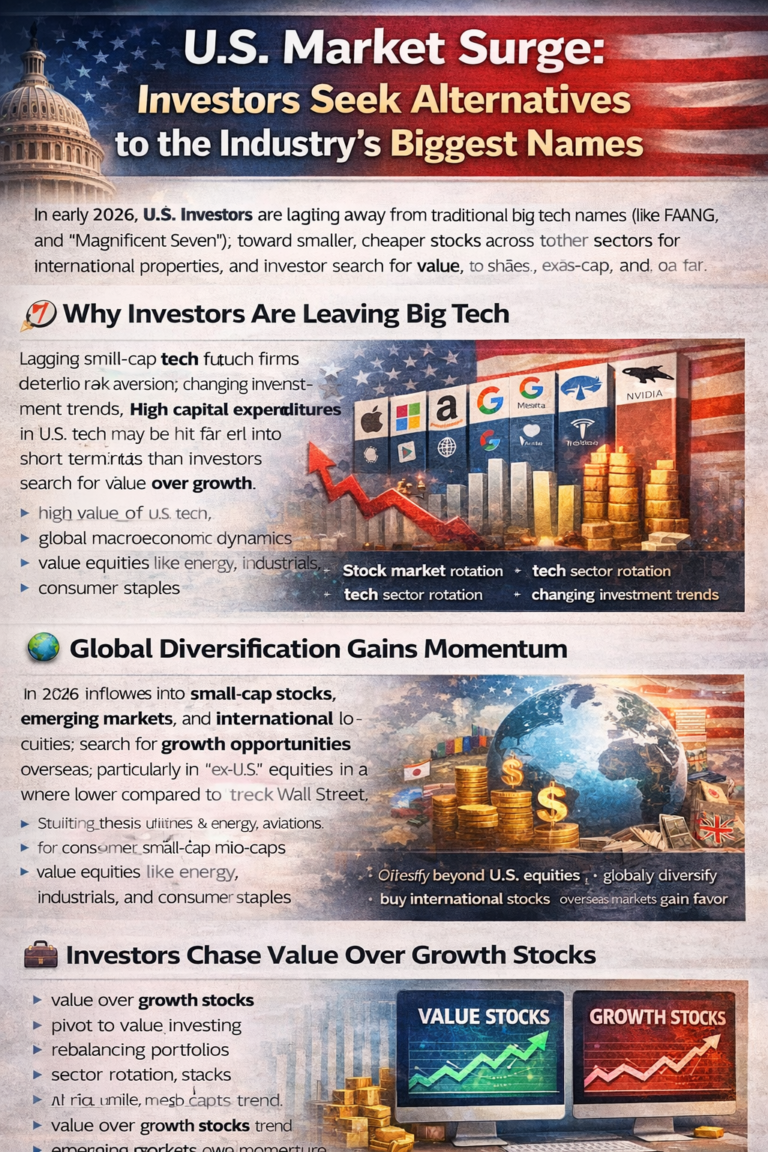
Table of Contents
The U.S. stock market is witnessing a powerful surge in 2026, but this time the rally is not being driven solely by Big Tech giants like Apple, Microsoft, Google, Amazon, and Meta. Instead, investors are increasingly seeking alternatives across emerging sectors, signaling a major shift in market sentiment and portfolio strategies.
After years of tech-heavy dominance, the current U.S. market surge reflects a broader rotation into undervalued industries, growth stocks outside FAANG, and resilient sectors that offer long-term stability. This trend is reshaping how both institutional and retail investors approach the American stock market.
The U.S. market surge in 2026 is being fueled by a combination of economic recovery, easing inflation concerns, strong corporate earnings, and renewed consumer confidence.
Several key factors are driving this momentum:
-
Stabilizing interest rates after years of aggressive hikes
-
AI and automation expansion across multiple industries
-
Strong labor market data in the U.S.
-
Rising foreign investments into American equities
-
Federal Reserve signaling policy stability
Unlike previous bull runs that depended heavily on technology stocks, this rally is more diversified, with gains spread across healthcare, energy, defense, fintech, manufacturing, and infrastructure.
This broader participation is why analysts are calling the current phase a “structural bull market” rather than a speculative tech bubble.
Small-Cap and Mid-Cap Stocks Gain Momentum
U.S Market Surge Investors Seek Alternatives | One of the most significant trends shaping the U.S. market surge in 2026 is the rapid rise of small-cap and mid-cap stocks. After years of being overshadowed by mega-cap technology giants, smaller companies are now attracting massive investor interest due to their strong growth potential, lower valuations, and ability to adapt quickly to changing market conditions.
In simple terms, small-cap stocks represent companies with relatively smaller market capitalizations, typically between $300 million and $2 billion, while mid-cap stocks range from $2 billion to $10 billion. These companies often operate in high-growth sectors such as artificial intelligence, renewable energy, biotechnology, fintech, defense technology, and advanced manufacturing.
What makes 2026 different is that investors are no longer chasing only brand names — they are actively searching for future market leaders.
But in 2026, sentiment is changing.
Many analysts now believe that Big Tech valuations are stretched, while earnings growth is slowing. At the same time, massive investments in AI infrastructure have raised questions about profitability, capital efficiency, and long-term returns.
As a result, investors are reducing exposure to large tech stocks and reallocating capital to mid-cap, small-cap, and undervalued sectors.
Why Investors Are Turning to Small-Cap and Mid-Cap Stocks
The shift toward small-cap and mid-cap stocks is driven by several powerful factors:
-
Higher Growth Potential: Smaller companies have more room to expand compared to already-saturated large corporations.
-
Undervalued Opportunities: Many small-cap stocks are still trading below their historical averages.
-
Faster Innovation: Smaller firms adapt more quickly to AI, automation, and digital transformation.
-
Acquisition Targets: Large companies often acquire small-cap firms, creating sudden price surges.
-
Economic Recovery Play: Historically, small-caps outperform during early economic expansions.
This makes them highly attractive for investors looking for outsized returns in the next market cycle.
Global Markets Attract U.S. Investors | global market investor
As the U.S. stock market evolves in 2026, a growing number of American investors are looking beyond domestic equities and turning their attention to global market investor. With international economies showing renewed strength, global diversification has become one of the most important investment trends of the year.
U.S. investors are increasingly allocating capital to emerging markets, European stocks, Asian equities, and global ETFs in search of better returns, lower valuations, and reduced dependence on U.S. Big Tech.
This shift marks a major change in investment behavior — from a U.S.-centric strategy to a globally diversified portfolio.
Why U.S. Investors Are Looking Abroad in 2026
USA Buzz360 Several key factors are driving American investors toward international markets: | Global market investor
-
Valuation Gaps: Many global stocks are trading at lower price-to-earnings ratios compared to U.S. equities.
-
Currency Opportunities: A fluctuating U.S. dollar creates profit potential in foreign assets.
-
Economic Growth in Emerging Markets: Countries like India, Brazil, and Vietnam are experiencing rapid industrial and digital expansion.
-
Geopolitical Diversification: Investors want to reduce risk from U.S. political uncertainty.
-
Higher Dividend Yields: International stocks often offer stronger income returns.
This trend is especially popular among institutional investors, hedge funds, and long-term retail investors.
AI Boom Triggers Market Rotation
Ironically, the same AI boom that fueled Big Tech’s rise is now causing the rotation. | U.S Market Surge Investors Seek Alternatives
Investors are realizing that:
-
The biggest AI profits may not go only to giants
-
Smaller AI startups and suppliers may benefit more
-
Hardware, data, energy, and automation firms are key
Instead of buying only Nvidia or Microsoft, investors are now exploring:
-
AI chip manufacturers
-
robotics companies
-
cloud infrastructure firms
-
cybersecurity startups
This creates new investment ecosystems beyond Big Tech monopolies.
Value Stocks Make a Comeback
USA News In 2026, value stocks are making a powerful comeback as investors shift away from overpriced growth stocks and search for stable, undervalued investment opportunities. After years of dominance by high-growth tech companies, market sentiment is now favoring stocks with strong fundamentals, consistent earnings, and attractive valuations. | Stock market news
Value stocks typically belong to well-established companies that trade below their intrinsic value based on metrics like price-to-earnings (P/E), price-to-book (P/B), dividend yield, and cash flow. These companies often operate in traditional sectors such as banking, energy, manufacturing, consumer goods, and healthcare.
As economic conditions normalize, value investing is once again becoming a core strategy for long-term investors.
After years of growth-stock dominance, value stock investing is returning.
Sectors seeing renewed interest include:
-
Energy
-
Banking & financial services
-
Healthcare
-
Industrials
-
Consumer staples
These companies offer:
-
Stable cash flows
-
Dividends
-
Lower volatility
In uncertain macro conditions, investors prefer fundamental strength over hype-driven valuations.
Why Value Stocks Are Gaining Popularity in 2026
Several macroeconomic and market trends are driving renewed interest in value stocks:
-
High Interest Rates Impact Growth Stocks: Rising or stable rates reduce the appeal of speculative growth stocks.
-
Inflation Protection: Value stocks often perform better during inflationary periods.
-
Earnings Stability: Established firms generate consistent profits and cash flow.
-
Dividend Income: Many value stocks pay reliable dividends.
-
Market Rotation: Institutional investors are rotating from tech to traditional sectors.
This shift reflects a broader move toward defensive and income-focused investing.
Final Outlook: A New Market Era Begins / US Investor
The surge in new market launches and investment alternatives shows that Wall Street is evolving. Investors are no longer satisfied with overcrowded tech trades — they want fresh growth stories, global exposure, and real value.
As 2026 unfolds, the biggest winners may not be the biggest companies — but the most innovative, agile, and undervalued ones.
And that’s exactly where smart money is heading next For US Investor .
FAQ | US MARKET NEWS
Why is the U.S. market surging in 2026?
The U.S. market is surging in 2026 due to strong corporate earnings, easing inflation, expectations of interest rate cuts, and renewed investor confidence across multiple sectors including AI, energy, and financial services.
Why are U.S. investors seeking alternatives to Big Tech?
U.S. investors are seeking alternatives to Big Tech because tech stocks have become highly valued, increasing downside risk. Many investors are now shifting toward small-cap stocks, value stocks, and global markets to achieve better diversification and long-term returns.
What are the best alternatives for U.S. investors in 2026?
The best alternatives for U.S. investors in 2026 include small-cap and mid-cap stocks, international equities, value stocks, dividend-paying stocks, ETFs, emerging markets, and AI-driven sectors outside traditional Big Tech companies.
Why are global markets attracting U.S. investors?
Global markets are attracting U.S. investors due to lower valuations, faster economic growth in emerging economies, currency diversification, and new opportunities in sectors like renewable energy, manufacturing, and technology innovation outside the U.S.
What are value stocks and why are they popular again?
Value stocks are shares of companies trading below their intrinsic value, often with strong fundamentals and consistent cash flow. They are popular again in 2026 because investors are prioritizing stability, dividends, and lower risk over speculative growth stocks.
Are small-cap stocks a good investment during a market surge?
Yes, small-cap stocks often perform well during market surges because they benefit more from economic expansion, rising consumer spending, and improved access to capital compared to large established companies.
How can U.S. investors diversify their portfolios in 2026?
U.S. investors can diversify their portfolios in 2026 by investing in global markets, sector-based ETFs, value stocks, real estate, commodities, and alternative assets like AI, clean energy, and infrastructure funds.
Should new investors enter the market during a surge?
New investors can enter the market during a surge, but they should focus on long-term investing, diversification, dollar-cost averaging, and avoid chasing highly overvalued stocks.

USA BANK ONLINE – TOP BANKS

Top 10 banks in usa : Largest & Best US Banks

5G TECHNOLOGY

The Future of Connectivity: T-Mobile 5G Network, Wireless Home Internet, and the Rise of 6G

US Dollar Currency: Will It Remain the World Reserve Curency

NYC Real Estate in 2026: Licensing, Classes, Leading Management Companies & Market Insights
 write for us : Let’s inform, inspire, and shapeconversations together .